
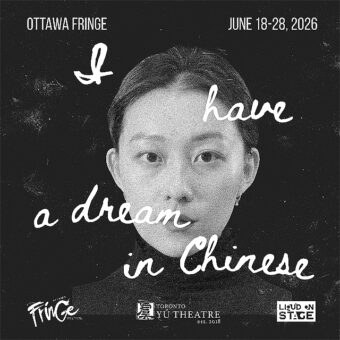
I have a dream in Chinese
Created by Irene (Fan) Yi | Produced by Liquid On Stage | Origin: Ottawa, Ontario
La Nouvelle Scène – Studio B





Show Details
A Chinese immigrant travels from Hong Kong to Vancouver while unraveling the fracture between her two names, two languages, and two homes. Blending poetic monologue, bureaucratic absurdity, and pandemic memory, this solo performance explores racism, exile, and identity. How do you begin again when you are still arriving?
Showtimes
- Friday, June 196:30pm
- Sunday, June 219:30pm
- Monday, June 229:00pm
- Wednesday, June 247:30pm
- ¹ Friday, June 2610:30pm
- Sunday, June 282:30pm
Good evening, passengers. Welcome aboard CX888 from Hong Kong to Vancouver. 各位旅客晚上好,欢迎搭乘国泰航空CX888航班,由香港飞往温哥华。
Please have your boarding pass ready. Please have your identification ready. Please be prepared to answer a few questions.
I have a dream in Chinese is a solo bilingual play moving through migration, racialization, and the unstable border between memory and survival.
I hear a scream. I’m back in the windowless workplace. I’m in the chair. Who are you. One interrogation after another. Then I’m standing on the chair, waving a piece of paper, until the chair disappears beneath me. I’m falling, falling, falling, and then — the sound of the sea.
It is a dream. Or it is not.
9 responses to “I have a dream in Chinese”
Leave a Reply
Our Sponsors




























As Canada makes it more difficult to come and stay here, our immigrant stories have to change, too: indeed, as their authors become ever more precarious and contingent, is “immigrant story” even the correct term any more?
A thoughtful, dreamlike show which confronts the audience up and down that axis.
What I think will stay with me the most is the brief moments when Charlee Ning 宁唯而 lets a mask slip into place, showing us the voice, the bearing, the attitude we expect from East Asian women, before she returns to a more natural register. A reminder that we should not confuse acquiescence to a stereotype for truth in that stereotype.
An intense play.
Well performed.
The modern Chinese immigration story has its own unique qualities, especially through the COVID years. This story also contains elements of most immigration and racialization experiences too.
An important story to be seen.
This play was a beautifully uncomfortable portrayal of the immigrant existential crisis for someone who is a CBC (Chinese born Canadian) – it felt like visually seeing the challenges my parents must have faced when they first arrived, but also the challenges of growing up Chinese in a predominately White neighbourhood. Having to constantly prove that Canada is “home”, watching a city you love (or “home”, culturally) fall apart, being “inbetween” two worlds and having to pick one only…
我是誰?家在哪?這部戲就好像把我人生中對我身份的迷茫濃縮成60分鐘的劇情一樣.
a great reminder that the COVID period fundamentally changed the trajectory of people’s lives and the places they live.
I’m deeply grateful to have seen such an important work at Ottawa Fringe… a piece that seems to try to make sense of the Chinese immigrant experience, contemporary experience, while also admitting that it can never be fully understood. It is complex, hard to put into words.
As immigrants, we are always somewhere in between. Sometimes we can’t help but look back to where we came from, and sometimes we are expected to blend in. The word “integrate” has appeared countless times in the rules I set for myself… how to behave, how to fit in, how to survive. But integration itself is a paradox…
The play feels like a dream, and it is structured like one, too. Scene after scene, it moves the way immigrant life in Canada often does: one interrogation after another. We are questioned by daily life, by work, and then, at night, by ourselves when we close our eyes.
A dream exists somewhere between (or beyond) reality and illusion. To me, that is the most precise and the most beautiful metaphor for the inner world of immigrants.
COVID permanently changed the way we look at the world. We never expected remote work to become normal life. We never expected that some versions of home would become impossible to return to. I also want to say this: the rhythm of contemporary immigration has changed forever. We run away, and yet the moment we land, we are still frightened.
We are always longing for home, always searching for home, and always trying to build a home that we can finally feel at peace with.
I strongly recommend this play. It may not be a dream that everyone has had. But I have.
This was a beautiful show with well done audio-visual components complimenting the in person performance very well. A balanced show with cheeky moments contrasted with emotional unsettle and deserved discomfort for those with the privilege of default citizenship in “Canada” + not a racialized person. I felt relatability as a mixed person while also feeling effectively checked and resulting in expanded thinking around the themes presented.
I am deeply related to this show after watching it. As an Asian who has lived here since childhood, I know firsthand the quiet struggle of feeling invisible. Our voices need to be heard, or at the very least, they deserve to exist in the open. For too long, our stories have been sidelined. It is time for us to share our stories, and ensure that our community’s presence is acknowledged, respected, and never ignored again.
This is a beautifully orchestrated, performed play. One of my favorites this year at Fringe. Thank you!
A very heartfelt cri de coeur about a first gen immigrant’s experience moving to Canada and experiencing culture shock and racialization. I appreciate how it really hones in on focusing on 2020s Mainland Chinese immigration experiences, drawing comparisons between lived experiences in Wuhan and Canada while also highlighting push factors particular to the pandemic, while also using universal inconveniences (e.g. CRA customer service calls; workplace conflicts) to show how they impact Mainland Chinese immigrants differently.
Also, shoutout to the actor doing an improv jam out to the tax receipts song during her preshow warmup!